Essential Craft · ExperienceOS working product · 2026
Designing magic moments as a repeatable innovation system
A working product that begins with a high-stakes human moment: getting married. It makes the path from emotional intent to journey signals, commercial measures and prioritised action visible in one system.
Quick read
How Magic Moments connects human need to measurable delivery
- My role
- Product & Experience Designer
- Key decision
- The key trade-off was breadth versus proof.
- Evidence
- Demonstrated scope: one wedding chapter connects six lifecycle phases, physical, digital and third-party signals, four journey routes per phase and a traceable value-generation backlog.
At a glance
- One human chapter connected across six lifecycle phases
- Customer evidence and commercial signals visible side by side
- Four journey routes modelled within each phase
- Evidence traced into prioritisation and active value generation
- Illustrative data clearly separated from real-world outcomes
Project snapshot
Scope and attribution
Working-product summary
- My role
- Product & Experience Designer
- Duration
- Self-directed product exploration · 2026
- Mandate
- Prove how an organisation can start with a meaningful human circumstance, rather than a product category, and carry that context through experience strategy, commercial decisions and delivery.
- Team and collaborators
- Independent Essential Craft concept, product design and build using an illustrative hospitality catalogue and sample data.
- What I owned
- Opportunity framing, human-chapter model, content architecture, journey framework, commercial measurement logic, product design, visual system and working prototype.
- What others owned
- There was no external client or implementation team. ExperienceOS was created independently to make the method tangible and testable.
- Constraints
- The concept had to connect emotional experience intent to practical organisational action in one navigable product, without presenting illustrative measures as real customer or commercial performance.
- Status
- The working product demonstrates the operating logic. It does not claim client implementation or downstream performance.
Evidence and confidentiality
The product, chapter model and interface are real project assets. Journey scores, feedback volumes and commercial measures are explicitly illustrative sample data created to demonstrate how the system works.
The challenge
Organisations usually organise innovation around products, channels and internal ownership. People do not. They experience a wedding as one consequential life moment crossing discovery, choice, booking, arrival, service, memory and return, with no tolerance for the organisation's seams.
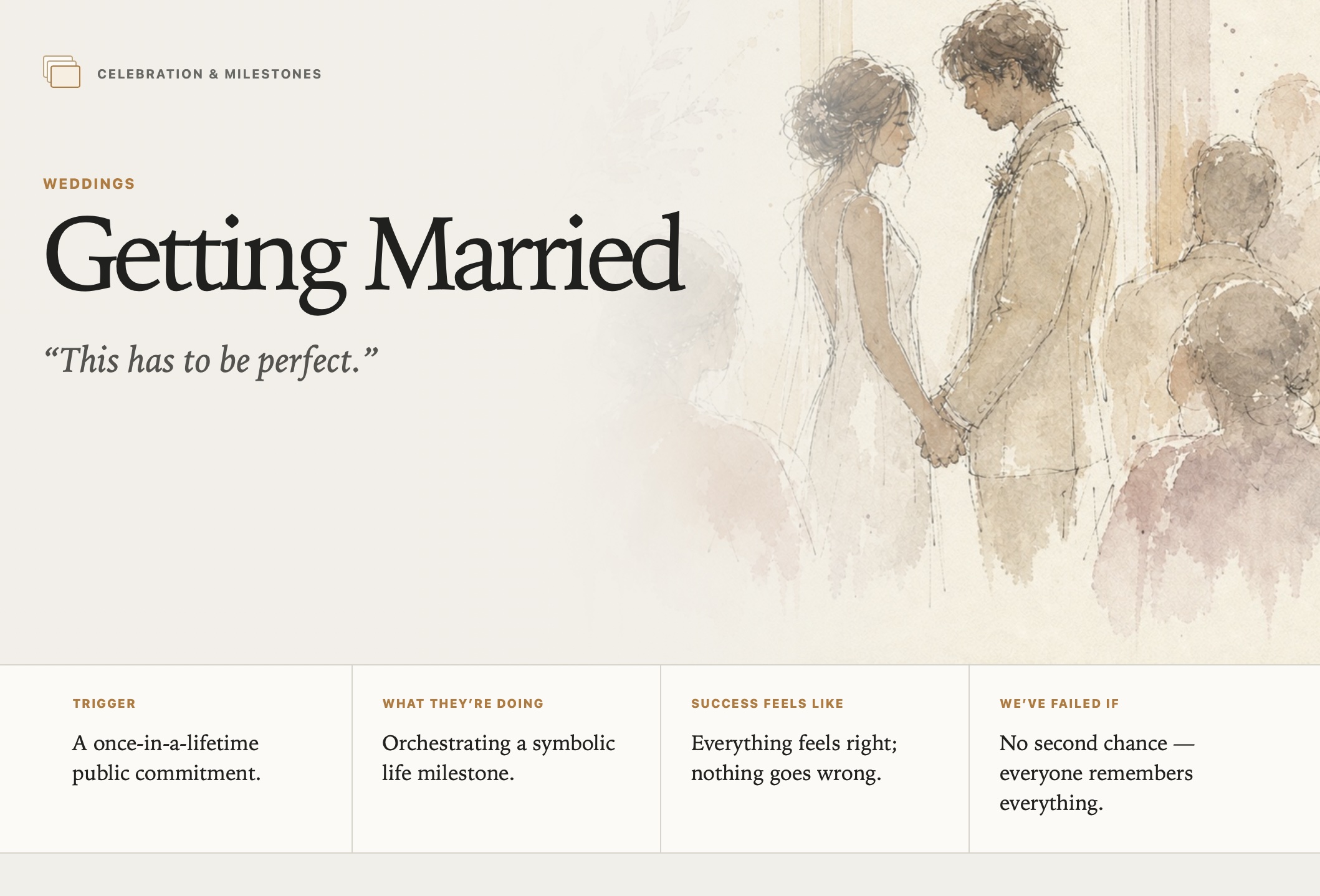
The ‘Getting Married’ chapter makes that tension explicit: ‘This has to be perfect.’ It is a once-in-a-lifetime public commitment where everything needs to feel right, nothing can go wrong and there is no second chance. The challenge was to preserve that emotional truth while translating it into decisions an organisation can own and deliver.
The approach
I framed the opportunity as a human chapter called ‘Getting Married’, with the structured business lens ‘Weddings’. The chapter defines the trigger, what people are trying to do, what success feels like and the distinctive risk of failure before introducing any property, package or channel.
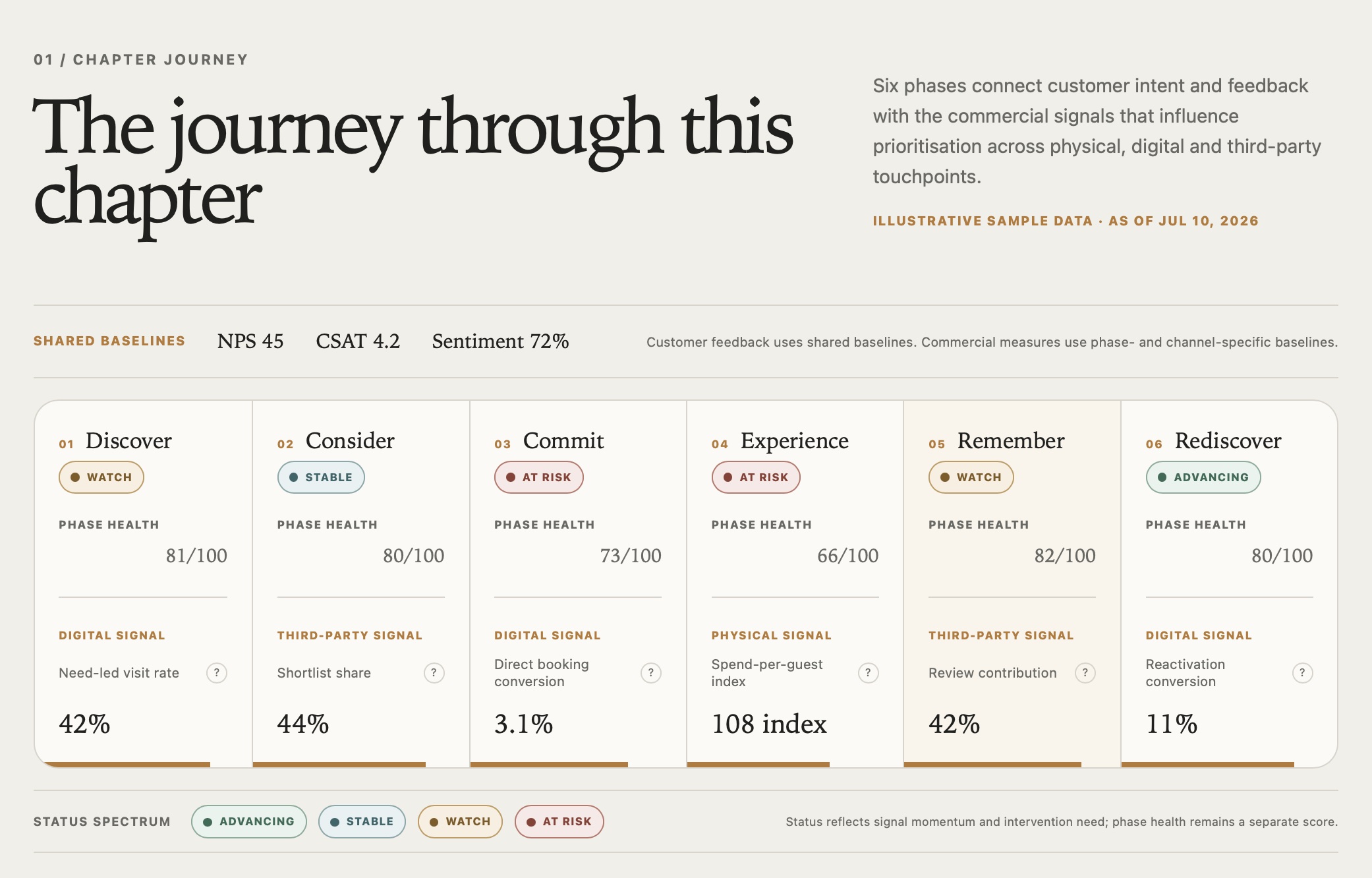
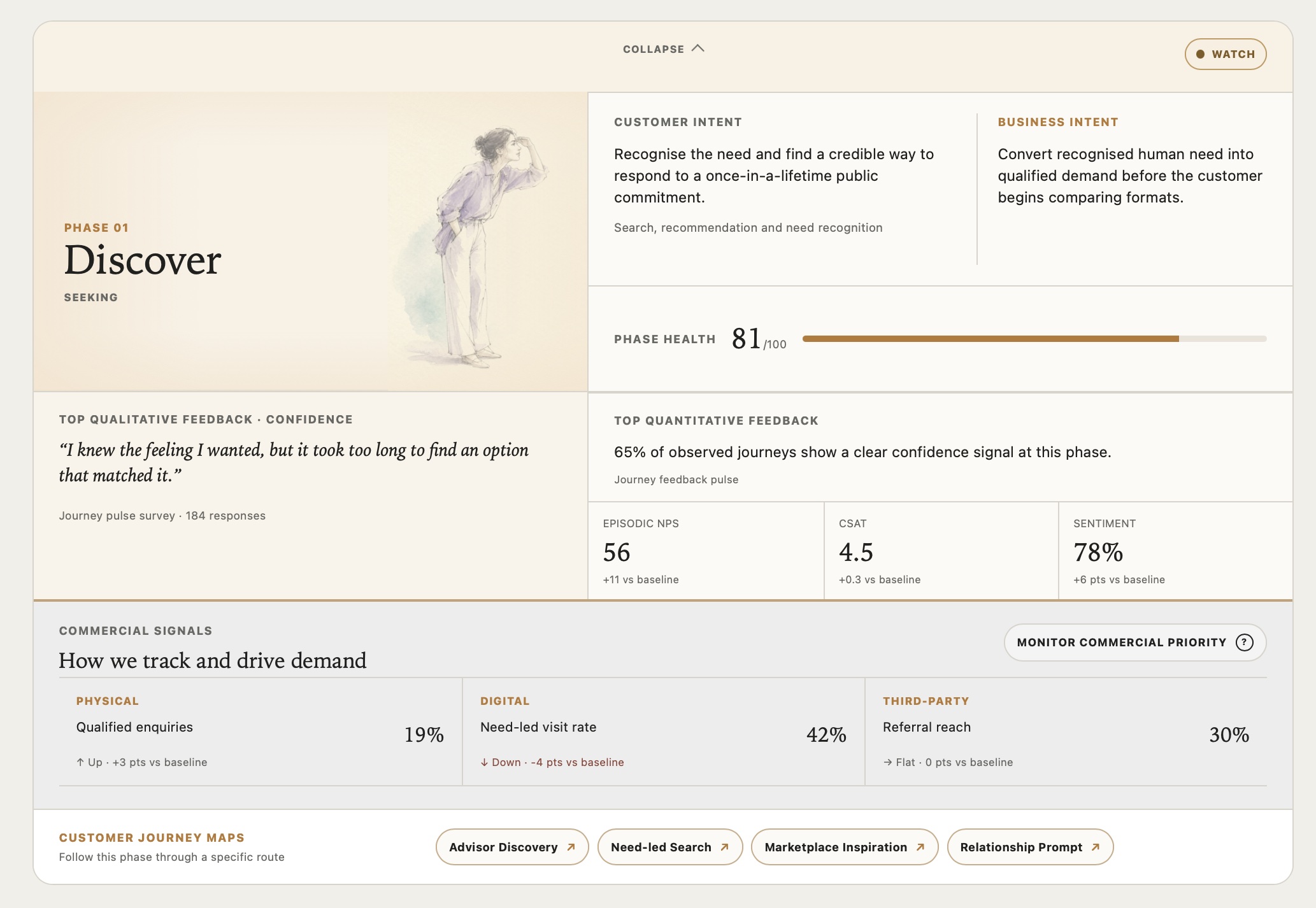
The chapter then runs through six connected phases: Discover, Consider, Commit, Experience, Remember and Rediscover. Each phase holds customer intent, qualitative and quantitative feedback, journey routes and commercial signals across physical, digital and third-party touchpoints.
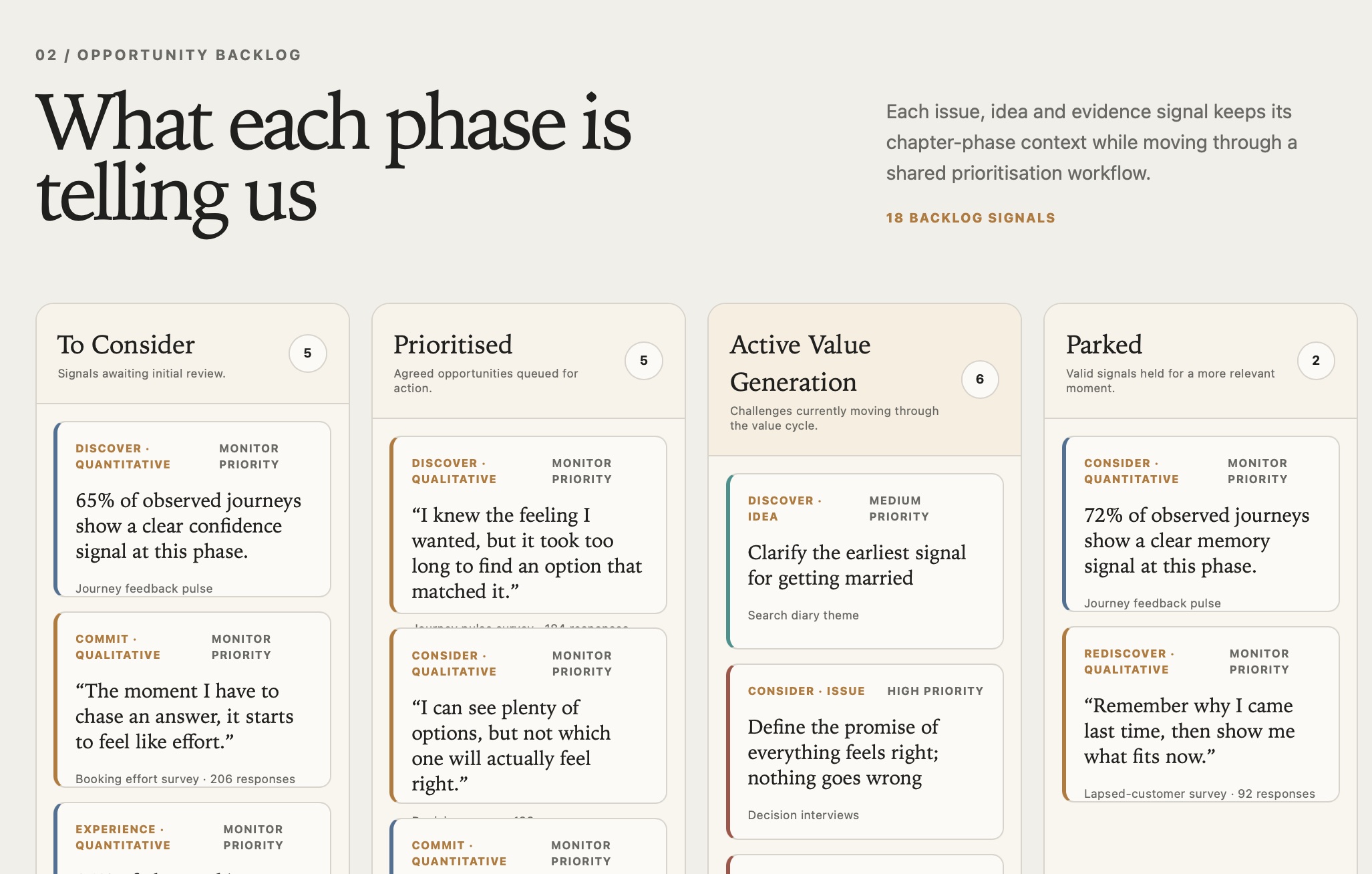
Finally, the same evidence feeds a visible backlog and value-generation pipeline. That connection turns ‘create a magic moment’ from a vague aspiration into traceable choices about what to investigate, prioritise, design, deliver and measure.
Outputs delivered
Product proof
Working-product outcomes
ExperienceOS shows how one high-stakes human chapter can move from customer evidence to prioritised work and outcome measures in one navigable system.
The model is designed to scale beyond weddings. The catalogue structure allows other human circumstances to reuse the same evidence, commercial and delivery logic while retaining their own emotional context and success criteria.
Business / customer evidence
- Demonstrated scope: one wedding chapter connects six lifecycle phases, physical, digital and third-party signals, four journey routes per phase and a traceable value-generation backlog.
- The working product demonstrates the decision system. It does not claim customer, revenue or operational improvement; the measures are illustrative.
Decision / trade-off
The key trade-off was breadth versus proof. I developed one consequential human chapter deeply enough to expose the full operating logic, rather than presenting a broad catalogue of attractive but disconnected experience ideas.
What I learned / next
Systematic innovation does not need to make experience less human. Starting with the moment people care about creates a stronger test for every commercial and delivery decision. The next step is to apply the model with live organisational data and compare prioritisation quality against an existing product-led process.
Continue exploring
Related evidence and approach
Related demo
Follow feedback into prioritised action
See the traceability discipline connect customer feedback, design decisions, delivery work and measurement.
How I work
Make the whole challenge visible
See the wider experience design approach behind connecting human evidence, organisational intent and delivery reality.
Start a conversation
Want to organise innovation around human moments?
Bring a consequential customer circumstance. I can help connect its human stakes to service decisions, commercial measures and prioritised work.